About
How Intensity Lab developed
From a self-funded site for California intensity reports, through simulated ground motion with SCEC and NVIDIA, to automated animations after real earthquakes.
-
Origin
A self-funded site for California intensity reports
Intensity Lab began as a self-funded website built by Philip Maechling to generate site-specific intensity reports for California earthquakes. The site polled the USGS ComCat catalog and published MMI notifications to its homepage and to social media after significant events. An early version generated Google Earth tours that opened above California, zoomed into the epicenter, then flew to the affected population center.
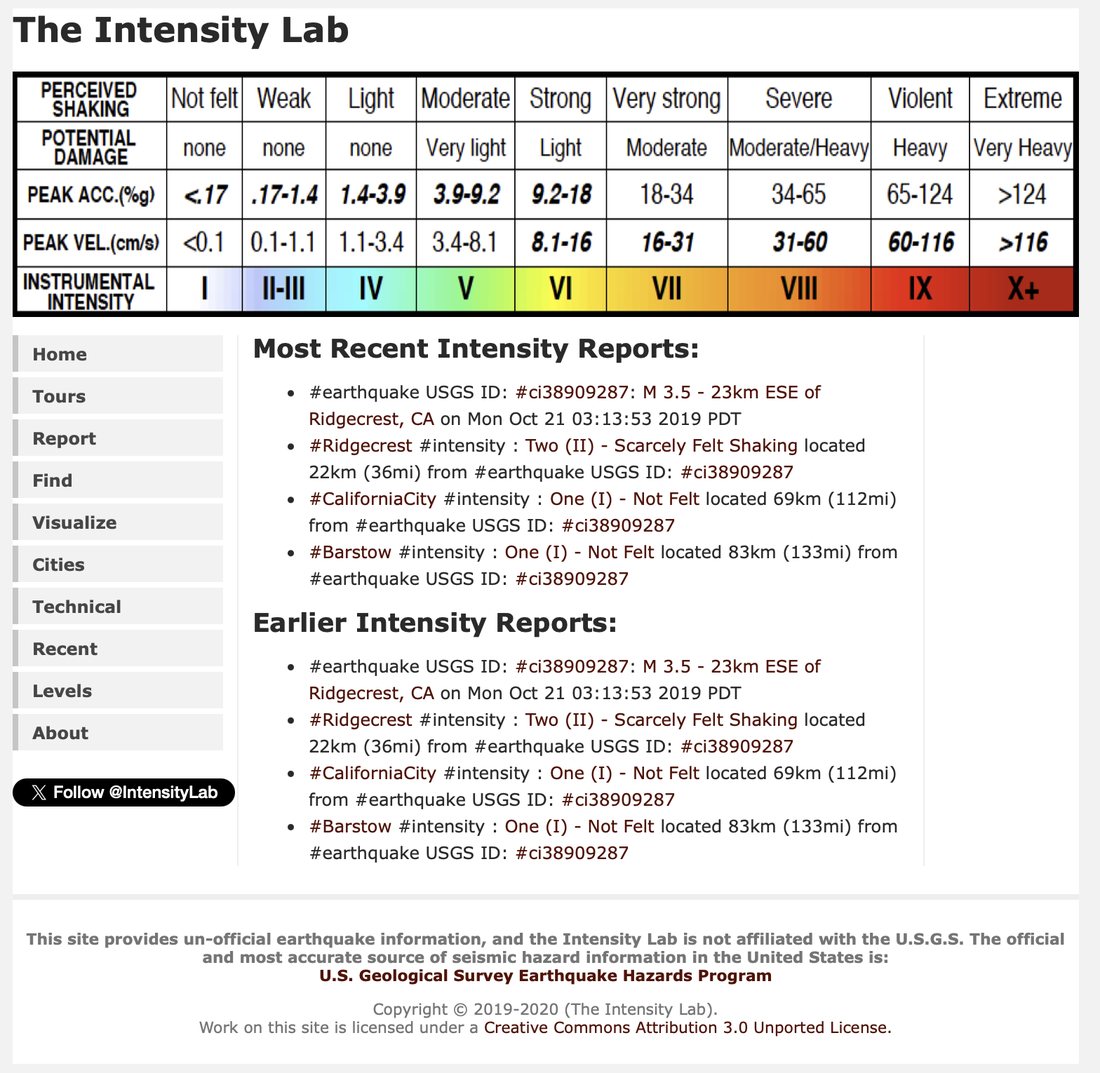
The site in 2020. Each report named a place, its intensity in words as well as Roman numerals, and its distance from the epicenter, and went out to social media as it was published. The format has changed; the argument has not. 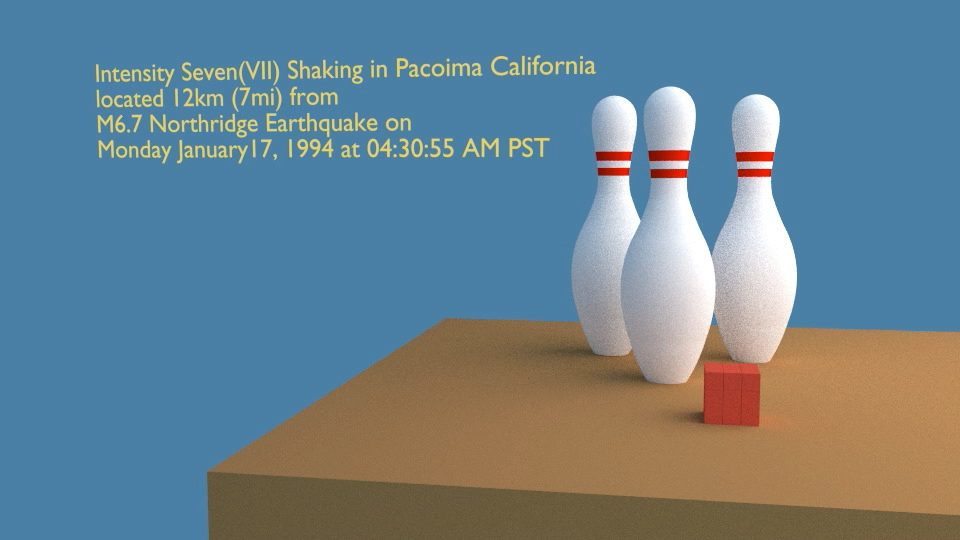
An early site-oriented intensity animation: Intensity VII shaking at Pacoima, 12 km from the 1994 M6.7 Northridge earthquake. The same idea drives the animations the site produces today. Credit: Philip Maechling. -
SCEC and NVIDIA
Simulated ground motion meets a production physics engine
Philip and other SCEC researchers worked with NVIDIA engineers to combine physics-based ground motion simulations with physics-based seismic intensity animations. Ground motions were computed with SCEC simulation software on GPU supercomputers; NVIDIA rendered the response of everyday objects to those motions with ray tracing and a rigid-body physics engine. The result was shown as an interactive demonstration at NVIDIA's SC19 exhibit in Denver, where an operator could feed in ground motions from a scenario earthquake and watch a room respond.

A site-oriented intensity animation of a kitchen 100 km from an M9.2 Cascadia earthquake, rendered with updated physics in March 2020. Credit: Peter Messmer and Mathias Hummel, NVIDIA. The collaboration established the point this site is built on: viewers understand immediately that intensity is site-based, and that two locations can experience the same earthquake very differently.
-
2026 to now
Acquired by Research Software Systems LLC
In 2026, intensitylab.com was acquired by Research Software Systems LLC, which has restarted development. The goal is to improve site-specific seismic intensity estimates and to build on the SCEC and NVIDIA work: intensity animations driven by physics-based ground motion simulations, produced automatically after real earthquakes rather than assembled by hand for a scenario.
Intensity Lab is an independent project and is not an official source of earthquake information. It is not affiliated with USGS, Caltech, SCEC, GEM, NVIDIA, or any other organization whose data or software it uses. Read the full disclaimer →