Modified Mercalli Intensity IV MMI IV: Light shaking
MMI four (IV) is light shaking. Felt by many indoors, few outdoors. At night some awakened. Sensation like a heavy truck striking the building. Typical peak ground acceleration is 1.4–3.9% of gravity, and it causes no damage.
What MMI IV does
- Perceived shaking
- Light
- Damage potential
- None
- Peak acceleration
- 1.4–3.9% g
- Peak velocity
- 3.4–8.1 cm/s
What people feel
- Felt by many indoors, few outdoors during the day
- Some people awakened at night
- No general alarm; mostly surprise
What objects do
- Dishes and windows rattle alarmingly
- Hanging objects swing noticeably
- Liquids slightly disturbed in open containers
- Small bells ring
What happens to buildings
- Walls creak noticeably
- Cars rock noticeably
- No structural damage
Also at this level, in other versions of the scale
- Sensation like a heavy truck striking the building USGS, The Modified Mercalli Intensity Scale (table image on that page)
Sources: the USGS Modified Mercalli Intensity scale (Wood and Neumann, 1931; Richter, 1958); ground-motion ranges from the USGS ShakeMap documentation (Worden et al., 2012), approximate and overlapping between neighbouring levels. See instrumental intensity. An older example: MMI four (IV) on YouTube.
Simulated at MMI IV
Our animations of named places where the estimated shaking reached this level, driven by simulated or recorded ground motion.
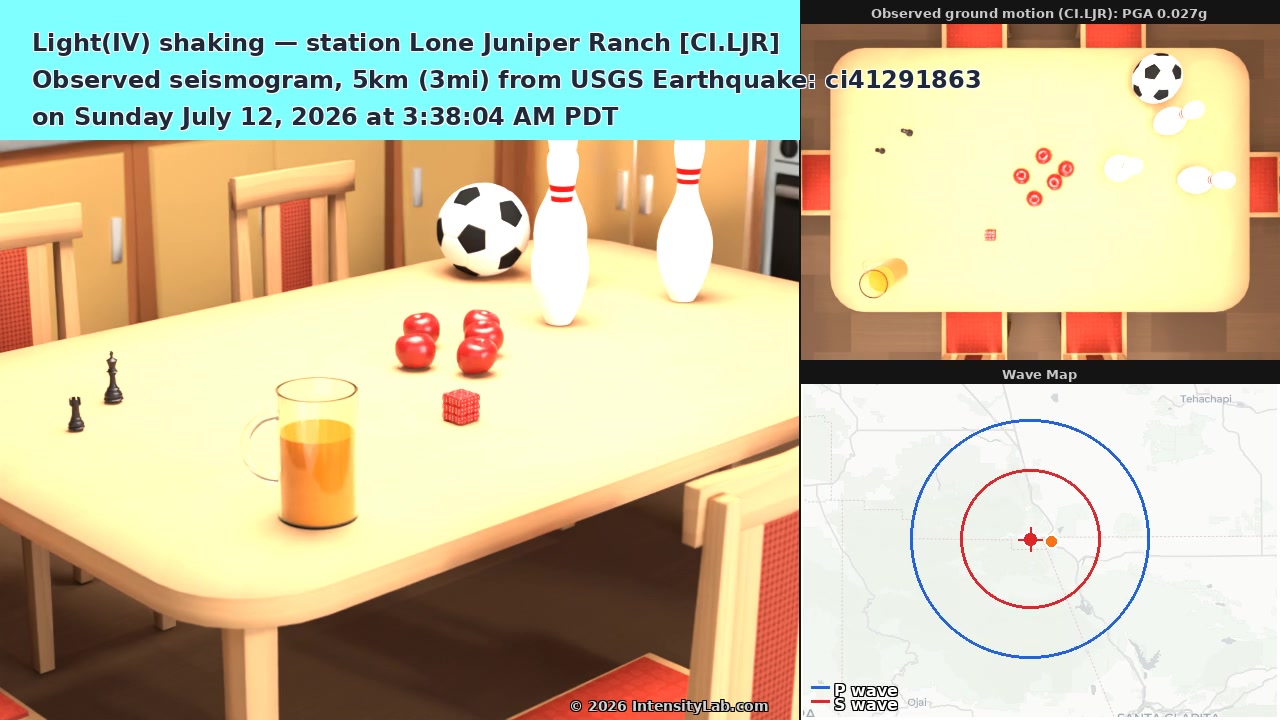
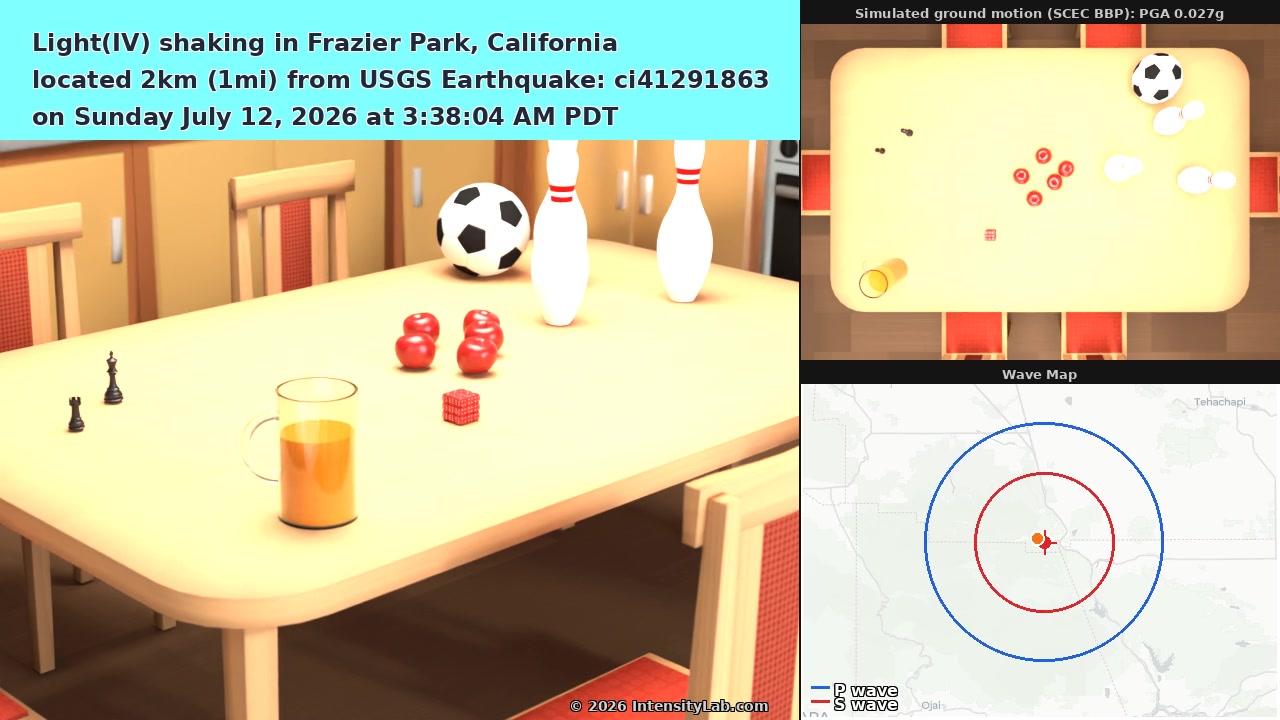
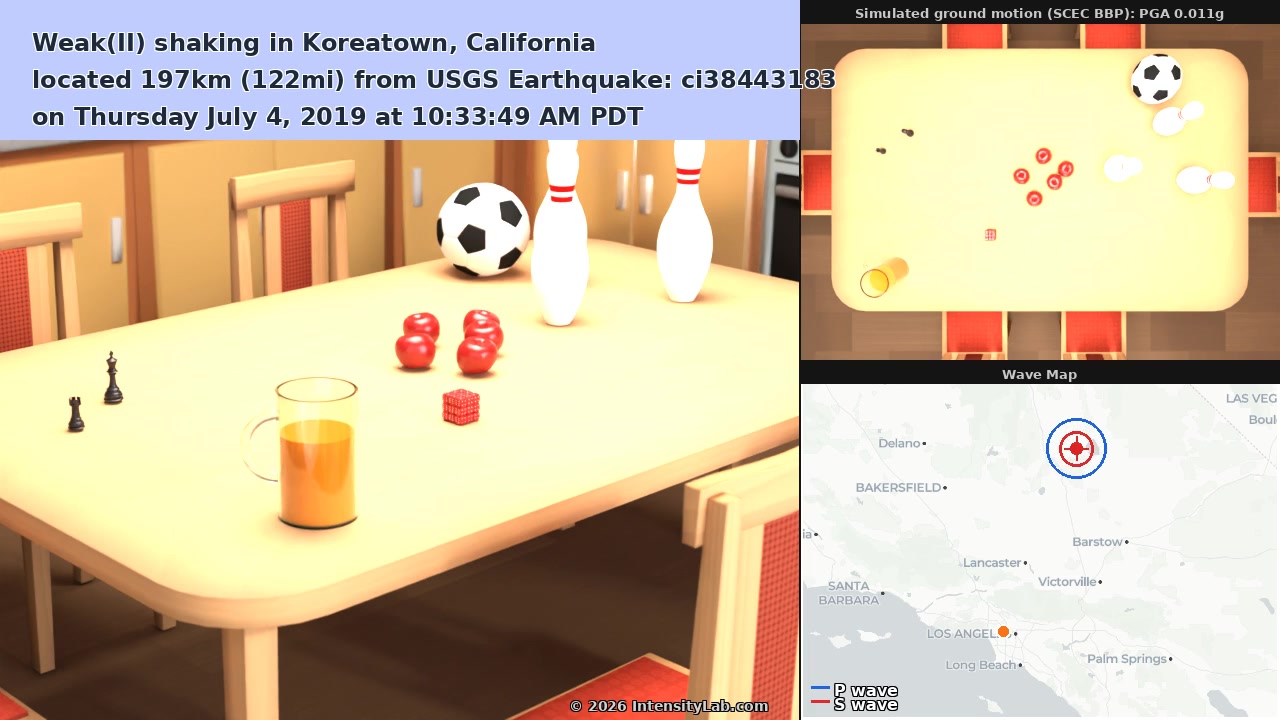
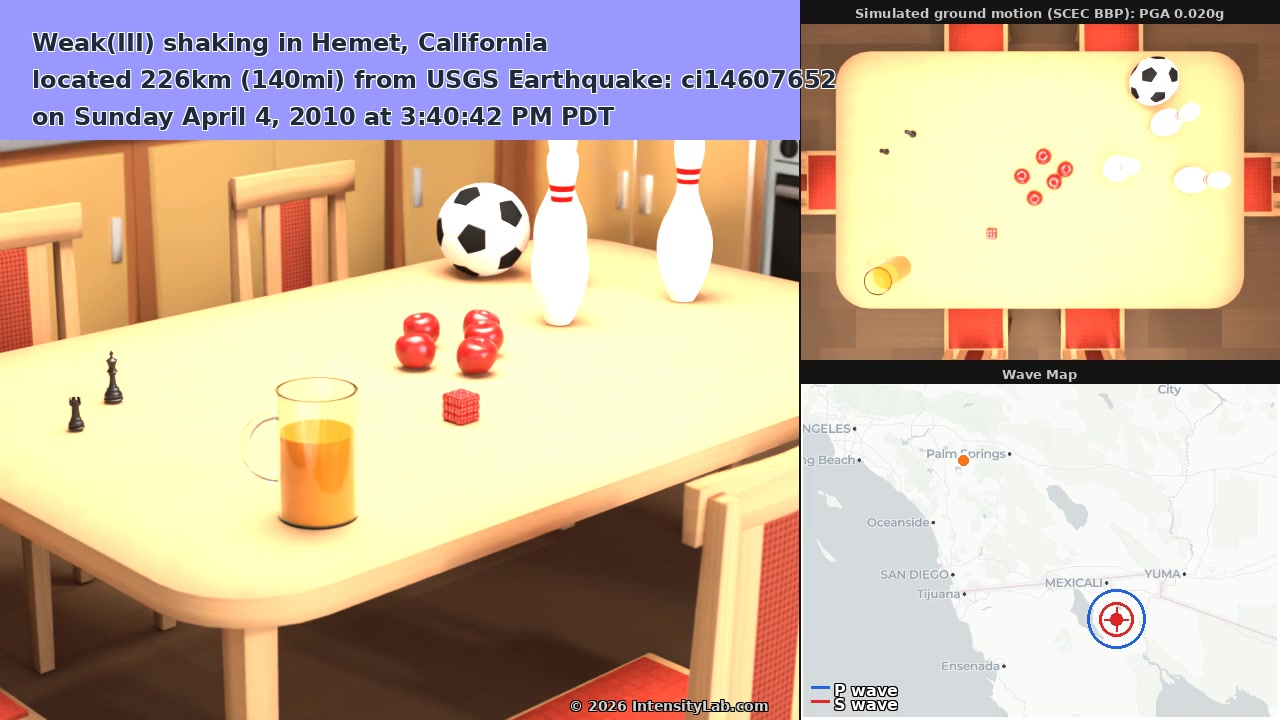
Recently at MMI IV in our region
Earthquakes in the western United States and northern Mexico whose strongest shaking at a named place reached this level.
-
M4.1
19 km SE of Joseph, Oregon
2026-11-10 · Joseph, MMI 3.7 IV -
M3.3
9 km WSW of South Lake Tahoe, CA
2026-10-02 · South Lake Tahoe, MMI 3.5 IV -
M3.5
20 km E of Castle Rock, Washington
2026-09-05 · Longview, MMI 3.5 IV -
M3.8
3 km N of San Leandro, CA
2026-08-13 · San Leandro, MMI 3.7 IV -
M3.7
7 km ESE of Cloverdale, CA
2026-08-01 · Cloverdale, MMI 3.6 IV
Seen on camera: no clips yet
Each clip is rated from the effects it shows. A rating describes one camera at one place, not a whole town.
How MMI IV is estimated
From instruments
USGS ShakeMap converts peak ground acceleration and velocity recorded at seismic stations into intensity. About 1.4–3.9% g of acceleration corresponds to MMI four (IV).
From people's reports
USGS Did You Feel It? turns answers from thousands of people into a community intensity for each place. If you felt an earthquake, report it there.
From footage
We rate each clip with questions built from the scale's own statements: what people, objects and buildings do on camera. A rating describes one camera at one place.
Common questions
What magnitude causes MMI IV?
It depends on distance and ground conditions, not magnitude alone. In our region, MMI four (IV) has come from earthquakes such as M4.1 near Joseph, Oregon (2026); M3.3 near South Lake Tahoe, CA (2026); M3.5 near Castle Rock, Washington (2026).
What does MMI IV feel like?
Felt by many indoors, few outdoors during the day. Some people awakened at night. No general alarm; mostly surprise.
How strong is the ground motion at MMI IV?
Peak ground acceleration is typically 1.4–3.9% g and peak velocity 3.4–8.1 cm/s.
How is intensity different from magnitude?
Magnitude measures the energy an earthquake releases and is one number per earthquake. Intensity describes the shaking at one place, so a single earthquake produces many intensities, strongest near the fault and weaker with distance.