Modified Mercalli Intensity V MMI V: Moderate shaking
MMI five (V) is moderate shaking. Felt indoors by practically all, outdoors by many. Many people awakened; a few run outdoors. Buildings tremble throughout. Typical peak ground acceleration is 3.9–9.2% of gravity, and the damage potential is very light.
What MMI V does
- Perceived shaking
- Moderate
- Damage potential
- Very light
- Peak acceleration
- 3.9–9.2% g
- Peak velocity
- 8.1–16 cm/s
What people feel
- Felt by practically all indoors, most outdoors
- Many awakened from sleep
- Few frightened; slight excitement
- A few people run outdoors
What objects do
- Dishes and glassware broken to some extent
- Windows cracked in some cases
- Vases and unstable objects overturned
- Hanging objects and doors swing considerably
- Pictures knocked against walls or swung out of place
- Doors and shutters open or close abruptly
- Liquids spilled from well-filled open containers
- Pendulum clocks stop, start, or change rate
What happens to buildings
- Buildings tremble throughout
- Possible very slight damage to buildings
- Trees and bushes shaken slightly
Sources: the USGS Modified Mercalli Intensity scale (Wood and Neumann, 1931; Richter, 1958); ground-motion ranges from the USGS ShakeMap documentation (Worden et al., 2012), approximate and overlapping between neighbouring levels. See instrumental intensity. An older example: MMI five (V) on YouTube.
Seen on camera: 7 clips rated MMI V
Each clip is rated from the effects it shows. A rating describes one camera at one place, not a whole town.
 V
Exterior parking lot with row of cars.
M7.7 10 km WSW of Pitaloza Arriba, Panama · 0:18
Seen: trees and bushes shaken slightly.
Setting: Trees, Vehicles
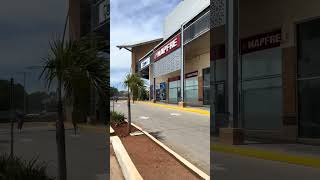 V
Exterior of commercial shopping strip mall
M7.7 10 km WSW of Pitaloza Arriba, Panama · Chitré, Herrera, Panama (stores) · 0:12
Seen: trees and bushes shaken slightly.
Setting: Trees, Stores
 V
Exterior of skyscraper and street level parking lot with cars
M7.7 10 km WSW of Pitaloza Arriba, Panama · 0:36
Seen: a few frightened; some run for shelter or outdoors.
Setting: Vehicles, Skyscraper
 V
Light fixtures swinging in hotel
M7.1 Ridgecrest Earthquake Sequence · 0:06
Seen: doors swing strongly; pictures knocked out of place.
Setting: Public spaces
 V
Interior of home during aftershock
M6.4 Ridgecrest Earthquake Sequence · 0:57
Seen: building trembles.
Setting: Long period, Homes
 V
Interior of two story single family house.
M6.0 The 2014 South Napa, California Earthquake · 0:21
Seen: a few frightened; some run for shelter or outdoors.
Setting: Homes
 V
San Francisco streets.
M6.9 The 1989 Loma Prieta, California Earthquake · 0:32
Seen: a few frightened; some run for shelter or outdoors.
Setting: Trees, Vehicles
Recently at MMI V in our region
Earthquakes in the western United States and northern Mexico whose strongest shaking at a named place reached this level.
-
M4.9
9 km N of Delta, B.C., MX
2026-11-03 · Nuevo León, MMI 4.9 V -
M4.5
2 km W of Brawley, CA
2026-05-10 · Brawley, MMI 5.1 V -
M4.4
3 km WSW of Brawley, CA
2026-05-10 · Brawley, MMI 5.0 V -
M4.4
2 km NW of The Geysers, CA
2026-05-07 · Cobb, MMI 4.6 V -
M5.2
19 km SE of Silver Springs, Nevada
2026-05-01 · Silver Springs, MMI 4.7 V
How MMI V is estimated
From instruments
USGS ShakeMap converts peak ground acceleration and velocity recorded at seismic stations into intensity. About 3.9–9.2% g of acceleration corresponds to MMI five (V).
From people's reports
USGS Did You Feel It? turns answers from thousands of people into a community intensity for each place. If you felt an earthquake, report it there.
From footage
We rate each clip with questions built from the scale's own statements: what people, objects and buildings do on camera. A rating describes one camera at one place.
Common questions
What magnitude causes MMI V?
It depends on distance and ground conditions, not magnitude alone. In our region, MMI five (V) has come from earthquakes such as M4.9 near Delta, B.C., MX (2026); M4.5 near Brawley, CA (2026); M4.4 near Brawley, CA (2026).
What does MMI V feel like?
Felt by practically all indoors, most outdoors. Many awakened from sleep. Few frightened; slight excitement. A few people run outdoors.
How strong is the ground motion at MMI V?
Peak ground acceleration is typically 3.9–9.2% g and peak velocity 8.1–16 cm/s.
How is intensity different from magnitude?
Magnitude measures the energy an earthquake releases and is one number per earthquake. Intensity describes the shaking at one place, so a single earthquake produces many intensities, strongest near the fault and weaker with distance.